


Most law firms know they need SEO. Fewer know what it should actually look like. And almost none get a straight answer from the agencies pitching them.
I run Waypoint Digital, an SEO agency in Melbourne. We’ve worked with law firms across the city, and our most notable result is a 490% increase in organic traffic for a Melbourne-based legal practice over 18 months. I’m going to walk you through exactly what SEO for lawyers looks like when it’s done properly, what we did to get that result, and how to evaluate whether your current agency (or the one you’re considering) is actually doing the right work.
This isn’t a DIY guide. This is for the partner or practice manager who wants to understand what they’re paying for and whether it’s working.
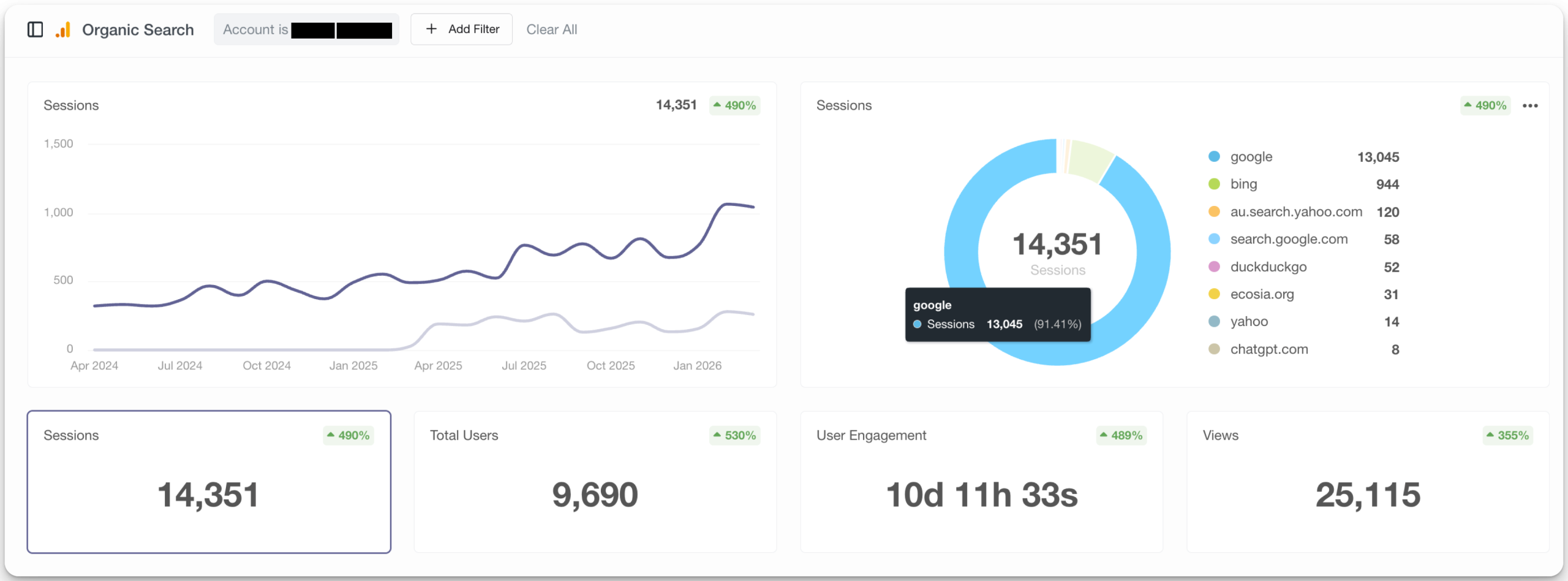
What We Did for a Melbourne Law Firm (And What Happened)
Our family law client came to us with a common problem. They had a website, but it wasn’t generating enquiries from organic search. They were relying on referrals and word of mouth, which is fine until it isn’t. Referrals aren’t scalable, and they’re unpredictable.
Here’s what we did.
Months 1-2: Audit and foundation. We started with a full technical audit and fixed the basics. Site speed issues, crawl errors, missing meta data, and a site structure that made it hard for Google to understand what practice areas the firm covered. We also optimised their Google Business Profile, which was incomplete and missing key practice area categories.
Months 3-4: Content strategy and production. We built out dedicated practice area pages with real depth. Not 200-word placeholder pages, but proper content that addressed the questions potential clients actually ask. We also started a blog targeting informational keywords that their ideal clients were searching.
Months 5-6: Link building and authority. We built backlinks from relevant Australian legal directories, local business directories, and industry publications. Quality over quantity. Every link was relevant and from a legitimate source.
Months 7-12: Compounding growth. This is where law firm SEO gets exciting. The work from the first six months started compounding. Rankings improved. Traffic grew. And most importantly, the phone started ringing with enquiries from people who found our client through Google.
The result: 490% organic traffic growth over 18 months. That’s not a vanity metric. That’s real people searching for legal services in Melbourne and landing on their website.
Every recommendation I make in this post is backed by that experience. We’ve done the work, measured the results, and know what moves the needle for law firms.
Why Legal SEO Is Different From Regular SEO
If you’ve spoken to a generalist SEO agency, they probably treated your law firm the same way they’d treat a plumber or a café. That’s a problem, because legal SEO has specific challenges that most agencies don’t understand.
Google classifies legal content as YMYL. YMYL stands for “Your Money or Your Life.” Google applies stricter quality standards to content that could affect someone’s financial stability, health, or legal rights. That means your website is held to a higher bar than a restaurant blog. Thin content, weak authority signals, or missing credentials will hurt you more than they’d hurt a business in a less regulated industry.
E-E-A-T matters more for law firms. Experience, Expertise, Authoritativeness, and Trustworthiness. Google wants to see proof that the people behind your website are actually qualified to give legal advice. I’ll cover exactly what that looks like in the next section.
Ethical advertising rules add complexity. Each state’s Law Society has rules about how lawyers can advertise. Your SEO agency needs to understand these constraints, particularly around claims, testimonials, and how outcomes are described. A generalist agency that doesn’t know the Law Institute of Victoria’s advertising guidelines could inadvertently create content that puts your firm at risk.
Legal keywords are expensive and competitive. The cost per click for legal terms in Google Ads can run $20 to $80+ in Australia. That’s actually good news for SEO, because it means the organic traffic you capture through SEO services for lawyers has enormous value. One client from organic search can be worth $5,000 to $50,000 or more depending on the practice area.
What E-E-A-T Actually Looks Like on a Law Firm Website
Every SEO guide mentions E-E-A-T. Few explain what it actually means in practice for a law firm. Here’s the checklist.
Lawyer bio pages with real detail. Not just a headshot and a paragraph. Include admission dates, courts you’re admitted to practise in, specific practice areas with depth, years of experience, and professional memberships. Link to your Law Society profile. If you’ve published articles, spoken at conferences, or been quoted in media, include that too.
Author attribution on every blog post. Every article on your site should have a named author who is a qualified lawyer at your firm. Not “Admin” or “Marketing Team.” Google wants to know that a real, credentialed professional wrote or reviewed the content.
Practice area pages with substance. A 200-word page that says “we do family law, contact us” isn’t going to rank. Your practice area pages need depth. Address the questions clients ask in their first meeting. Explain the process. Cover common scenarios. Show that your firm genuinely understands this area of law.
Schema markup for legal services. Structured data helps Google understand your website. Use LegalService schema on your practice area pages and Attorney schema on your lawyer profiles. This improves how your site appears in search results and helps Google connect your content to relevant queries.
Client testimonials and case examples. Within the bounds of your state’s advertising rules, include testimonials from past clients and examples of case outcomes. These build trust with both Google and potential clients. Be careful with how you frame outcomes, and always check your Law Society’s guidelines on what you can and can’t say.
If your website is missing more than two of these elements, that’s likely holding your rankings back. These aren’t optional for law firms. They’re the baseline.
Local SEO for Lawyers: The Melbourne Market
Most people looking for a lawyer want one near them. “Family lawyer Melbourne,” “criminal lawyer western suburbs,” “employment lawyer CBD.” These are the searches that drive real enquiries, and they’re where local SEO for lawyers makes the biggest difference.
Your Google Business Profile is your digital shopfront. If your GBP is incomplete, has the wrong categories, or hasn’t been updated in months, you’re invisible in the local pack. That’s the map section at the top of Google results, and for legal searches, it’s where most clicks go. Make sure your GBP has accurate practice area categories, up-to-date business hours, recent photos, and a steady stream of client reviews.
Melbourne’s legal market has suburb-level dynamics. A family lawyer in the western suburbs faces different competition to a commercial lawyer in the CBD. The western suburbs (Melton, Caroline Springs, Werribee) have fewer established firms competing for local terms, which means faster wins with less investment. The CBD and inner east are denser, more competitive, and require more aggressive content and link building to break through.
Reviews drive local rankings. Google pays attention to review volume, recency, and quality. Law firms that actively request reviews after matters close consistently outrank those that don’t. Set up a simple process: when a matter wraps up successfully, send a follow-up email with a direct link to your Google review page. Aim for consistent, steady reviews rather than a burst followed by silence.
Location pages for each service area. If your firm serves clients across multiple suburbs or regions, consider building location-specific pages. “Family lawyer Footscray” is a different search from “family lawyer Melbourne.” These pages need unique content, not just the suburb name swapped in. Address the specific court or tribunal that services that area, local referral networks, or community context.
What to Expect From a Law Firm SEO Campaign
One of the biggest frustrations law firms have with SEO is not knowing what’s actually happening. Here’s what a properly run campaign looks like, month by month.
Month 1-2: Audit, strategy, and technical fixes. Your agency should start by understanding your firm, your practice areas, your competition, and your goals. They’ll run a technical audit, fix site speed and crawl issues, optimise your GBP, and develop a keyword strategy. If an agency skips this step and jumps straight into “content creation,” be cautious.
Month 3-4: Content production and on-page optimisation. This is where practice area pages get built or rewritten, blog content starts publishing, and internal linking gets structured properly. Your agency should be producing content that targets specific keywords identified in the strategy phase.
Month 5-6: Link building and early results. Quality link building starts. You should begin seeing movement in rankings for lower-competition keywords. Your agency should be reporting on keyword positions, organic traffic trends, and any technical issues they’ve addressed.
Month 7-12: Compounding growth. The earlier work starts compounding. Higher-competition keywords begin ranking. Organic traffic grows month over month. Enquiries from organic search increase. By month 12, you should have a clear picture of ROI.
What realistic results look like: For a Melbourne law firm with moderate competition, expect to see meaningful ranking movement within 4-6 months and consistent traffic growth by month 8-12. Anyone promising page one rankings in 30 days is either lying or planning to use tactics that will get your site penalised.
How to Choose an SEO Agency for Your Law Firm
Not all SEO agencies are equipped to handle legal. Here’s what to look for and what to avoid.
Green flags:
✅ A track record with law firms. Ask for case studies. If they can’t show you results from a legal client, they’re learning on your dollar.
✅ Understanding of Law Society advertising rules. Your agency should know that legal content has compliance requirements. If they’ve never heard of YMYL or E-E-A-T, that’s a problem.
✅ Transparent reporting with commentary. Monthly reports should explain what was done, what changed, and what’s planned next. A spreadsheet of numbers with no narrative is not a report.
✅ Month-to-month contracts. Agencies that deliver results don’t need to lock you into 12-month contracts.
Red flags:
🚩 Guaranteed rankings. No one can guarantee a number one position on Google. The algorithm changes constantly. If they’re guaranteeing rankings, they’re either lying or they’re going to use risky tactics.
🚩 No audit before quoting. If an agency gives you a price without first understanding your website, your competition, and your market, they’re pricing generic work. Your firm deserves a custom strategy.
🚩 No access to your own accounts. Your Google Analytics, Search Console, and Google Ads accounts should be owned by your firm, not your agency. If they won’t give you access, they’re creating dependency.
🚩 Offshore link building with no transparency. Ask where your backlinks come from. If they can’t or won’t tell you, those links are probably low quality and could eventually trigger a Google penalty.
SEO for Lawyers and AI Search: What’s Changed in 2026
Google AI Overviews are now appearing in search results, and they handle legal queries with more caution than most other topics. Because legal content is YMYL, Google is selective about which sources it cites in AI-generated answers. It favours authoritative, well-structured content from credible sources.
What does this mean for your law firm? The same E-E-A-T signals that help you rank in traditional search also determine whether your content gets cited in AI answers. Proper author attribution, structured FAQ content, practice area depth, and schema markup all feed into AI visibility.
Cheap SEO that produces thin, generic content won’t get picked up by AI search. Properly executed legal SEO, with genuine expertise signals, positions your firm to be visible in both traditional results and AI-generated responses.
This is another reason to invest in quality over shortcuts. The bar for legal content is only going up.
Let’s Talk About Your Firm
If you’re a law firm in Melbourne and you want to see what SEO could do for your practice, I’m happy to have the conversation. We’ve done it before, we have the results to prove it, and we’ll show you exactly what a campaign would look like for your firm.
Get in touch for a no-pressure chat about your goals.
Common Questions About Law Firm SEO
How much does SEO cost for a law firm?
Most law firms should budget $3,000 to $8,000 per month for a properly managed SEO campaign. The exact cost depends on competition in your practice area and location. We’ve written a detailed breakdown of SEO costs in Australia if you want the full picture.
How long until I see results?
For Melbourne law firms with moderate competition, expect meaningful ranking movement within 4-6 months. Consistent traffic growth typically follows by month 8-12. Highly competitive practice areas (personal injury, criminal law in the CBD) may take longer.
Can I do SEO myself as a lawyer?
You can handle some basics, like optimising your Google Business Profile and requesting client reviews. But effective legal SEO requires technical expertise, consistent content production, and strategic link building. Most lawyers are better off focusing on practising law and partnering with an agency that understands legal SEO.
Is SEO better than Google Ads for law firms?
They serve different purposes. Google Ads delivers immediate visibility for high-intent searches, but you pay for every click ($20-$80+ for legal terms in Australia). SEO takes longer to build but creates a compounding asset. The traffic you earn through SEO doesn’t stop when you stop paying. For most firms, a combination works best: ads for immediate lead flow, SEO for long-term, sustainable growth.
What practice areas benefit most from SEO?
Every practice area benefits, but family law, personal injury, criminal law, employment law, and immigration law tend to have the highest search volume and strongest commercial intent. These are also the most competitive, which is why quality SEO matters more than budget SEO in these areas.