
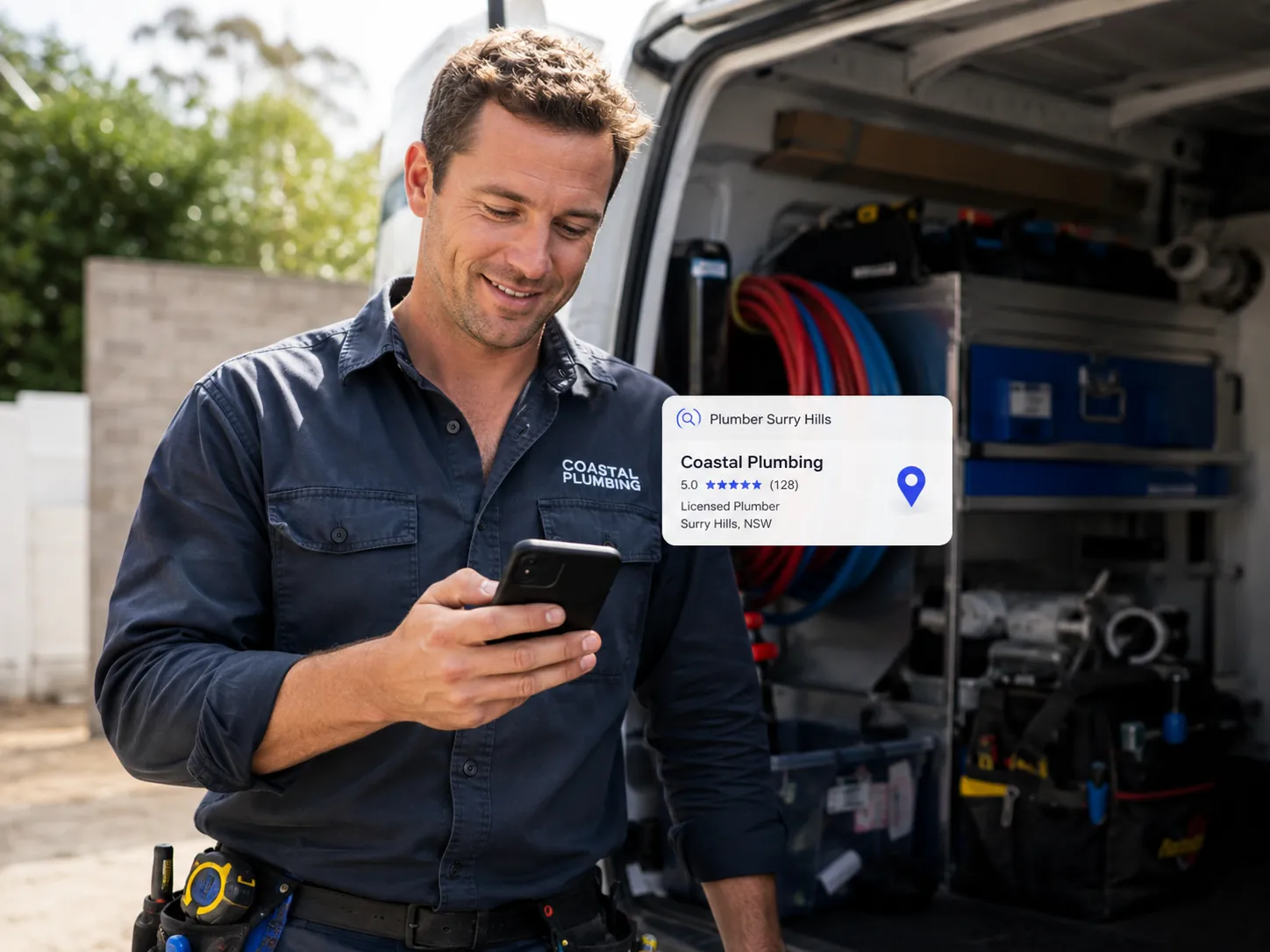

Most articles about SEO for tradies are written by marketers who have never stood in a ute at 7am wondering why the phone has gone quiet. They talk about “dominating Google” and “skyrocketing your leads,” then conveniently skip the bits that actually matter: what it costs, how long it takes, and which half of it is a waste of your money.
I run a small SEO agency in Melbourne’s west. A good chunk of our clients are tradies, sparkies, plumbers, builders, the people who keep the suburbs running. This is what I’ve learned actually moves the needle for a trade business, what I’d tell you to skip, and how to spot an agency that’s about to burn your budget. I’ll back it up with real numbers from our own trade clients, not made-up promises.
Does SEO Actually Work for Tradies?
Yes, and for most trades it works better than it does for almost any other type of business. Here’s why.
When someone needs a tradie, they’re not browsing. They’ve got a burst pipe, a dead hot water system, or a switchboard that’s tripping. They grab their phone, search “emergency plumber” plus their suburb, and they call one of the first businesses they see. That’s high-intent, ready-to-buy traffic, and it lands in your area, not somewhere across the country you can’t service.
Compare that to a national e-commerce brand fighting for broad keywords against companies with million-dollar budgets. You don’t have to win Australia. You have to win your service area. That’s a fight a one-van operator can genuinely compete in, and win.
To put real numbers on it: Pipe Dream Plumbing, a family-run plumber out in Melbourne’s western suburbs, came to us with low rankings for location-based searches and almost no organic traffic. We built suburb-specific service pages and went after high-intent local keywords. In the first year, organic sessions increased by 252% and organic users by 200%, with 68 of their 78 tracked keywords now ranking. That’s the kind of result a local trade business can realistically get from doing the fundamentals properly.
The catch is that the way people find tradies has shifted. Three things have changed in the last couple of years:
- The Map Pack sits above everything. The little box of three businesses with the map is where most local clicks now happen, often before anyone scrolls to the regular results.
- AI answers are creeping in. Google’s AI Overviews and tools like ChatGPT now summarise answers before a user clicks anything. Being the business those tools mention matters more every month.
- Trust signals are the tiebreaker. When two plumbers both rank, the one with 80 reviews at 4.8 stars gets the call over the one with six reviews. Google knows that, so it weights it.
What Actually Works (In Priority Order)
If you only did the things in this section and ignored everything else, you’d still beat most of your competitors. This is the order I’d tackle them in.
1. Your Google Business Profile
This is the single most important asset for a trade business, full stop. It’s what gets you into the Map Pack, and it’s free. Claim it at business.google.com, get your primary category exactly right (“Electrician,” not “Home Services”), fill in every single field, and add real photos of your work, not stock images.
Then keep it active. Post once a week, answer questions, and reply to every review. Google rewards profiles that look alive. A half-finished profile that hasn’t been touched in a year will get outranked by a complete one that’s updated weekly, every time.
2. Reviews, and asking for them properly
Reviews influence both where you rank in the Map Pack and whether someone actually picks you. The mistake most tradies make is waiting for reviews to happen on their own. They don’t.
Build the ask into the job. When you finish, send a follow-up text with a direct link to your Google review page. Make it a two-tap job for the customer. Five reviews a month for a year beats 30 in one week followed by silence, because Google looks at how recent and how consistent your reviews are.
One warning: don’t only ask your happy customers, and never buy reviews. Google calls that review gating, it’s against the rules, and profiles get suspended for it. Not worth the risk.
3. A website with a page for every service and suburb
Your Google Business Profile gets you on the map. Your website is what ranks you in the normal results below it and convinces people to actually call.
Don’t cram everything onto one page. A plumber needs separate pages for blocked drains, hot water, gas fitting, and general plumbing. Each one targets a different search. The same goes for the areas you cover. “Electrician Caroline Springs” and “Electrician Melton” are different searches with different competition, and each deserves its own page with genuine, unique content, not the same paragraph with the suburb name swapped in.
This is the part most tradies underestimate. It’s also the part that compounds. Every solid service-and-suburb page is another door into your business from search. Building out those suburb pages was the single biggest lever in the Pipe Dream campaign above.
4. Local citations and consistent business details
Your business name, address, and phone number (the industry calls it NAP) need to be identical everywhere they appear online. Not similar. Identical. “Joe’s Plumbing” and “Joe’s Plumbing Pty Ltd” look like two different businesses to Google, and that confusion weakens your local ranking.
Get listed in the directories that matter in Australia (Google, Bing Places, Apple Maps, True Local, Yellow Pages) and the trade-specific ones like hipages and ServiceSeeking. Use the exact same details every time. It’s tedious. It also works.
Free Download
Get the Local SEO Checklist for Tradies
The same step-by-step checklist we use when we onboard a new trade client. Google Business Profile, reviews, suburb pages, citations, the lot, in priority order. Print it, pin it to the wall, or hand it to whoever runs your marketing.
What’s a Waste of Your Money
This is the section the sales pages leave out, because some of this is what they’re selling you.
Cheap link packages. If someone offers you “500 backlinks for $99,” run. Those links come from spammy directories and dodgy networks, and at best they do nothing. At worst they get your site penalised, and cleaning that up costs far more than the links ever did.
Targeting broad, national keywords. You do not need to rank for “plumber” across all of Australia. You need to rank for “plumber” plus the suburbs you actually service. Chasing the broad term burns budget on traffic that will never become a paying job.
Locking into a long fixed contract before you’ve seen any work. SEO takes time, that part is true. But a good agency earns the next month by showing you what they did this month. Be wary of anyone who wants a 12-month lock-in before they’ve lifted a finger.
Paying for traffic reports that don’t mention jobs. Impressions and rankings are nice, but they don’t pay your wages. If your monthly report is all vanity metrics and never mentions calls, enquiries, or booked jobs, you’re paying for a dashboard, not results.
How to Spot an Agency That’s About to Burn Your Budget
The trades world is full of marketing operators who know tradies are busy and don’t have time to check the work. A few warning signs worth knowing:
- They guarantee a #1 ranking. Nobody can guarantee that. Google’s results change constantly and no agency controls them. A guarantee is a sales tactic, not a strategy.
- They can’t explain what they’ll actually do. If you ask “what will you do in month one?” and you get buzzwords instead of a plain answer, that’s your sign.
- They won’t give you access to your own accounts. Your Google Business Profile, Google Analytics, and Search Console should be in your name. If an agency keeps them locked away, you’re a hostage, not a client.
- The reporting never connects to revenue. Good reporting tells you what changed, what it means, and what’s next, in language you understand.
The honest version of this work isn’t flashy. It’s consistent execution, real content, proper local optimisation, and a monthly conversation about what’s working. That’s what we built our tradie SEO service around, and it’s why our trade clients stay.
How Much Does SEO for Tradies Cost in Australia?
The honest answer is “it depends,” but here’s what it depends on, in order of how much it moves the price.
How competitive your trade and area are. A solo handyman in a regional town is a cheaper campaign than a plumbing company fighting for emergency work across metro Melbourne. More competition means more content and more work to rank.
How many services and suburbs you want to rank for. Each one is another page and another set of keywords to earn. A plumber wanting to rank for four services across six suburbs is a bigger job than one wanting to rank for one service in one suburb.
For most Australian trade businesses, a proper local SEO campaign through an agency runs between roughly $1,000 and $3,000 a month. Below about $500 a month, there simply aren’t enough hours in the budget to do the work properly, which is why ultra-cheap SEO almost always disappoints. If you want the full breakdown, I’ve written a detailed piece on what SEO costs in Australia.
The number that should matter to you isn’t traffic, it’s leads. When we worked with McDowell Building & Construction, a builder with decades of experience but almost no online footprint, we paired a targeted SEO campaign with a rebuilt website. Organic traffic increased by 121%, but the figure Patrick actually cared about was the 72% increase in qualified leads. That’s the difference between SEO that looks good on a chart and SEO that fills your calendar.
How Long Before You See Results?
If you’re in a low-competition area, you can see movement in the Map Pack within four to eight weeks of doing this properly. The map results tend to respond faster than the regular organic results below them.
In a competitive metro market, expect three to six months of consistent work before the results feel meaningful. SEO compounds. The tradies who stick with it for 12 months build a genuine lead pipeline that keeps paying off. The ones who try it for a month, don’t see instant results, and quit are the ones who end up renting leads from paid ads forever.
The Honest Bottom Line
SEO for tradies works, and it works in a way that favours small, local operators who do good work. You don’t need a huge budget. You need your Google Business Profile sorted, a steady stream of reviews, a website with proper service and suburb pages, and someone keeping it all consistent month after month.
Most of the basics in this guide you can do yourself. Where tradies hit a wall is finding the time to keep at it while running a business. That’s the bit we handle.
Free Resource
Download the Local SEO Checklist for Tradies
The exact checklist we work through with every new trade client. Use it to audit your own Google Business Profile, reviews, website, and citations, and tick off the wins as you go.
Pop your name and email in. We’ll send the PDF straight through.
Want a Second Pair of Eyes on Your Local Visibility?
If you’ve worked through this guide and you’re not sure where you stand, or you’re already paying someone and the leads just aren’t coming, it’s not too late to get it sorted. Book a free 30-minute call and we’ll run through where your trade business sits in local search right now, what’s holding you back, and what work would actually move the needle.
Related reading: how SEO pricing actually works in Australia and the local SEO checklist we use with new clients.
Want Us to Handle It For You?
If you’ve read this far and thought “I’d rather be on the tools than fiddling with Google,” that’s exactly why we exist. We’re a Melbourne-based agency, finalists for Best Small SEO Agency at the APAC Search Awards 2026, and we run SEO for tradies across trades all over Australia. No lock-in nonsense, no vanity reports, just honest work that turns searches into booked jobs.
Get in touch for a no-obligation chat about your local visibility
Common Questions About SEO for Tradies
Is SEO worth it for a small trade business?
For most trades, yes. Trade searches are high-intent and local, which is the easiest kind of traffic to convert and the easiest kind for a small operator to compete for. You’re not fighting the whole country, just the businesses in your service area.
What’s the difference between SEO and Google Ads for tradies?
Google Ads gets you to the top instantly, but the leads stop the moment you stop paying. SEO takes longer to build but keeps working after the upfront effort, and the leads don’t switch off when you pause spending. Plenty of tradies run both: ads for immediate work while SEO builds in the background.
Can I do SEO for my trade business myself?
The basics, yes. Claiming and filling out your Google Business Profile, asking for reviews, and fixing your business details across directories are all things any tradie can do. Where most people run out of road is consistent content, the technical side, and keeping it up month after month. That’s usually where an agency earns its keep.
What is local SEO for tradies?
Local SEO is the part of SEO focused on ranking for searches with geographic intent, like “electrician near me” or “plumber Footscray.” For tradies it leans heavily on your Google Business Profile, reviews, and local citations rather than broad national content. It’s where the quickest wins usually come from. You can read more on our local SEO page.
How do I choose an SEO agency for my trade business?
Look for one that explains what they’ll actually do in plain English, gives you ownership of your own accounts, reports in terms of enquiries and jobs rather than just rankings, and doesn’t lock you into a long contract before doing any work. If they guarantee a #1 ranking, walk away.