
There’s a new acronym doing the rounds: GEO.
Generative Engine Optimisation. If you’ve been anywhere near a marketing blog or LinkedIn feed in the last six months, you’ve probably seen it positioned as the next big thing. The replacement for SEO. The future of search.
Here’s what I think: most of what people are calling GEO is just good SEO done properly. And if you’re already doing SEO well, you’re closer to “GEO-ready” than you think.
I run Waypoint Digital, an SEO agency in Melbourne. We’ve been doing AI search optimisation work for our clients alongside traditional SEO for over a year now. I’m going to cut through the noise and explain what GEO actually is, what it means for Australian businesses, and why the core work hasn’t changed as much as the hype suggests.
What Is GEO, and Why Is Everyone Talking About It?
GEO stands for Generative Engine Optimisation. It’s the practice of optimising your content so it gets picked up, cited, and recommended by AI-powered search tools like Google AI Overviews, ChatGPT Search, and Perplexity.
Traditional SEO focuses on ranking your website in Google’s organic results. GEO focuses on getting your content referenced in AI-generated answers. When someone asks ChatGPT “what’s the best way to waterproof a bathroom in Melbourne?” or Google’s AI Overview summarises the answer at the top of the results page, GEO is about making sure your content is the source that AI pulls from.
The reason everyone is talking about it is simple: AI Overviews are now live in Australia. They appear above the traditional search results for a growing number of queries. ChatGPT Search is gaining users. Perplexity is becoming a genuine research tool. If your content only ranks in the blue links but never gets cited by AI, you’re missing a growing share of visibility.
That’s real. That matters. But here’s where the conversation goes sideways.
The GEO Hype Is Overcomplicating Something Simple
Most GEO content online falls into two camps.
Camp one: “SEO is dead, GEO is the future.” This is fear-mongering. SEO is not dead. Google still processes billions of traditional searches every day. The blue links aren’t going anywhere. AI Overviews appear on a fraction of queries, and even when they do, they cite pages that already rank well organically. If your site doesn’t rank in traditional search, it’s not going to get cited in AI answers either.
Camp two: “GEO is a completely new discipline with its own strategies.” This is overcomplicated. Yes, there are some specific tactics that help with AI visibility (I’ll cover those). But the foundation of GEO is the same foundation as good SEO: create genuinely helpful content, demonstrate real expertise, build authority, and make your content easy for machines to understand.
The truth is somewhere much simpler. GEO is the natural evolution of SEO, not a replacement for it. If you’ve been cutting corners with thin content, keyword stuffing, and cheap backlinks, GEO will hurt you because AI models are even better than Google at detecting low-quality content. If you’ve been doing SEO properly, structured content, genuine expertise, clear answers, proper schema, you’re already doing 80% of GEO without realising it.
The Google Search Essentials still focus on the same core principles: helpful content, technical accessibility, and avoiding spam.
What GEO and SEO Have in Common (Which Is Almost Everything)
Let me show you how much overlap there is.
Quality content wins in both. Google’s helpful content guidelines reward content that demonstrates E-E-A-T: Experience, Expertise, Authoritativeness, and Trustworthiness. AI models use the same signals to decide which sources to cite. If your content is genuinely helpful, well-structured, and written by someone with real expertise, it performs well in both traditional and AI search.
E-E-A-T is the shared foundation. Author bios, professional credentials, real experience, specific examples, cited sources. These matter for Google rankings and they matter for AI citations. An AI model deciding whether to reference your content asks the same question Google does: is this source credible?
Technical SEO carries over completely. Site speed, mobile responsiveness, clean HTML, proper heading hierarchy, crawlability. All of it matters for both. If your technical SEO is solid, your content is already in the best possible shape for AI to read and reference.
Structured data helps both. Schema markup (FAQ schema, HowTo schema, LocalBusiness schema) helps Google understand your content and it helps AI models extract specific answers. This isn’t new GEO work. It’s technical SEO that good agencies have been doing for years.
Backlinks still signal authority. AI models assess source credibility partly by how many other authoritative sites reference you. That’s exactly what backlinks do. A strong backlink profile helps you rank in Google and get cited by AI.
What GEO Adds on Top (The 20% That’s New)
There are some tactics that are more specifically useful for AI visibility. This is the work that sits on top of a solid SEO foundation.
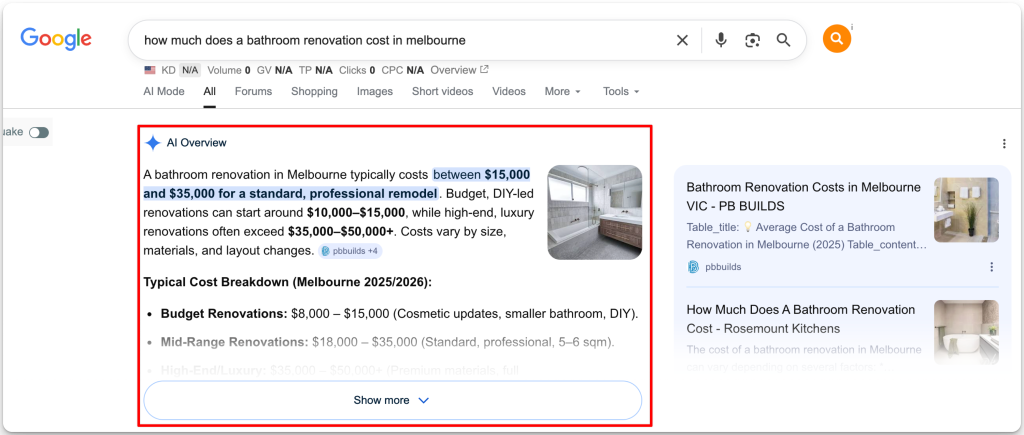
Direct, concise answers to specific questions. AI models love content that provides clear, direct answers. If someone asks “how much does a bathroom renovation cost in Melbourne?”, and your content opens with a clear answer (“A full bathroom renovation in Melbourne typically costs between $15,000 and $35,000”) before going into detail, AI is more likely to cite you. Write like you’re answering a question, not building suspense.
Structured content with clear hierarchies. Break your content into logical sections with descriptive headings. Use FAQ sections where appropriate. Format key information as clean lists or tables. AI models parse structured content more easily than long, unbroken paragraphs.
Statistics and specific data points. AI models prefer content that includes verifiable data. “Our clients see an average of 40% traffic growth in 6 months” is more citable than “our clients see significant growth.” Specificity makes your content more useful as a source.
Consistent, accurate entity information. AI models cross-reference your business details across the web. Your business name, address, services, and key facts should be consistent everywhere, from your website to your Google Business Profile to your directory listings. This is just local SEO done properly, but it feeds directly into how AI models assess your authority.
Natural language that mirrors how people ask questions. AI search is conversational. People ask “who’s the best plumber near Caroline Springs” rather than typing “plumber Caroline Springs.” Content that uses natural, conversational language to answer real questions performs better in AI results than content stuffed with exact-match keywords.
What This Means for Australian Businesses
If you’re a business owner in Melbourne or anywhere in Australia, here’s the practical takeaway.
You don’t need a separate GEO strategy. What you need is good SEO that’s done thoroughly and properly. That means quality content written by someone who understands your industry, proper technical foundations, genuine authority building, and structured content that both humans and machines can understand.
AI visibility is a bonus of doing SEO right, not a separate service. Any agency selling you “GEO” as a completely separate product on top of your SEO is either overcharging you or they weren’t doing proper SEO in the first place. At Waypoint, AI search optimisation is built into our SEO campaigns because the fundamentals are the same.
The businesses that will struggle are the ones cutting corners. If your website has thin service pages, no blog content, no schema markup, no author bios, and a handful of dodgy backlinks, you’re going to become less visible in both traditional and AI search. The bar for content quality is going up, not down.
The businesses that will thrive are the ones investing in genuine expertise. If your content is genuinely helpful, if your website demonstrates real experience, if your SEO agency is building real authority through quality content and legitimate link building, you’re already positioned for AI search.
The Red Flags in the GEO Conversation
Be cautious of agencies and consultants making these claims.
“You need to completely rebuild your SEO strategy for AI.” No, you don’t. You need to ensure your existing strategy is solid and layer in some AI-specific optimisations. A complete rebuild is usually a sales tactic.
“Traditional SEO is dead.” Traditional search still drives the vast majority of website traffic for Australian businesses. AI Overviews appear on a fraction of queries. Anyone telling you to abandon traditional SEO is giving you dangerous advice.
“We can guarantee you’ll appear in AI Overviews.” Nobody can guarantee this. AI results are less predictable than traditional rankings. What you can do is put your content in the best possible position to be cited. That’s what good SEO does.
“GEO requires expensive new tools.” The core work uses the same tools as SEO: Google Search Console, analytics, keyword research platforms, and content management. There are some emerging AI visibility tracking tools, but they’re supplementary, not essential for the foundational work.
How We Approach AI Search Visibility at Waypoint
When we run an SEO campaign for a client, AI visibility is built in from the start.
Here’s what that looks like in practice.
We start with the same foundation we’ve always used: technical audit, keyword strategy, content plan, authority building. Then we layer in the AI-specific work. FAQ schema on relevant pages. Structured content with clear question-and-answer formatting. Author attribution with real credentials. Consistent entity information across all platforms. Content that answers questions directly before expanding into detail.
We don’t sell GEO as a separate package because it’s not separate work. It’s what happens when SEO is done to the standard it should be done to. Our Starter, Growth, and Performance tiers all include these elements because they make the SEO better, not just the AI visibility.
The result? Our clients rank in traditional search and their content is positioned for AI citations. One set of work, two channels of visibility.
Stop Overthinking GEO
If you take one thing from this post, let it be this: don’t let the GEO hype distract you from doing SEO properly. The businesses that win in AI search are the same businesses that win in traditional search. They have helpful content, genuine expertise, clean technical foundations, and real authority.
GEO isn’t a revolution. It’s SEO growing up.
If you’re an Australian business wondering whether your SEO is “AI-ready,” the answer is probably simpler than you think. Fix your foundations, produce genuinely expert content, and make it easy for both humans and machines to understand. That’s it.
If you’d like someone to assess where you stand, we’re happy to have the conversation.
Common Questions About GEO and AI SEO
What is GEO in SEO?
GEO stands for Generative Engine Optimisation. It’s the practice of optimising your content to be cited and referenced by AI-powered search tools like Google AI Overviews, ChatGPT Search, and Perplexity. It builds on the same principles as traditional SEO: quality content, authority, technical health, and structured information. Google has published its own guidance on how AI features work with your website, and the advice is clear: the same foundational SEO best practices apply.
Is GEO replacing SEO?
No. GEO complements SEO. Traditional search still drives the majority of website traffic for Australian businesses. AI search is a growing channel, but it hasn’t replaced organic search. The best approach is solid SEO that naturally positions your content for AI visibility as well.
Do I need a separate GEO strategy?
In most cases, no. If your SEO is being done properly (quality content, E-E-A-T signals, structured data, clean technical foundations), you’re already doing the core GEO work. Some AI-specific optimisations like FAQ schema, direct answer formatting, and consistent entity data can be layered on top. But these are additions to good SEO, not a separate discipline.
How do I know if my content appears in AI Overviews?
Google Search Console now reports on AI Overview impressions and clicks alongside traditional search data. There are also emerging tools that track AI citations across platforms. The most practical approach is to search for your key terms in Google with AI Overviews enabled and see whether your content appears.
What does AI search optimisation cost?
At Waypoint, AI search visibility is included in our standard SEO campaigns because the work overlaps so heavily. You shouldn’t need to pay significantly more for “GEO” on top of a properly run SEO campaign. If an agency is quoting you a large additional fee for AI visibility, ask exactly what work is included that isn’t already part of their SEO offering.